Category: Trending · Privacy & Cybersecurity
In 2026, as dark web scams, phishing schemes, and AI-generated traps keep increasing, the Ahmia Dark Web Search Engine emerges as the safest and most reliable option for navigating public .onion services. Unlike other uncensored engines, Ahmia prioritizes harm reduction, ethical exploration, and legitimate research purposes.
Endorsed by the Tor Project since 2014 and consistently ranked #1 or “safest overall” in 2026 cybersecurity reviews, Ahmia has become the preferred search engine for journalists, OSINT analysts, security teams, and beginners seeking reduced exposure risk.
What Is a Dark Web Search Engine and How Does It Work?
A A dark web search engineis a unique tool crafted to discover and catalog hidden websites on the Tor network, particularly those that end with .onion. Ahmia is a filtered option built for legitimate use on the Tor anonymity network, making it safer than uncensored alternatives; its search interface can be opened in a regular browser, but reaching onion sites and their onion content still requires Tor and the correct onion address or onion version.
Because of this, dark web search engines help users discover content within encrypted, privacy-focused networks that would otherwise be difficult to navigate.
Unlike surface web search engines, dark web search engines require the Tor Browser and are built to prioritize anonymity, encryption, and protection from tracking. Popular examples include Haystack and Torch.
Key Features of Dark Web Search Engines
- Tor-Based Access: Tor-Based Access: A regular browser may open a clearnet search page, but reaching an onion version or any onion address still requires Tor Browser or another Tor-compatible connection.
- Hidden Site Indexing: Crawls and catalogs unindexed
oniondomains - Anonymity Protection: Tor routes traffic through multiple relays to help mask user identity
- Decentralized Structure: Often community-run with no single centralized index, and these tools help users discover onion sites and onion content rather than the entire dark web
How Dark Web Search Engines Work
Dark web search engines operate similarly to traditional search engines but face unique technical and structural limitations.
- They use Tor to route traffic through multiple relays to help mask identity
- They rely on automated crawlers and community discovery to index onion domains rather than every hidden site
- Their indexes change frequently because onion links often go offline, move, or return blocked content, so comparing Ahmia with similar engines can help surface more relevant results
As a result, dark web search results are often smaller and less consistent than those on the surface web. Despite these limitations, they remain essential tools for navigating the dark web safely and efficiently.
This article is for educational and cybersecurity awareness purposes only.
What Is Ahmia? Core Features in 2026
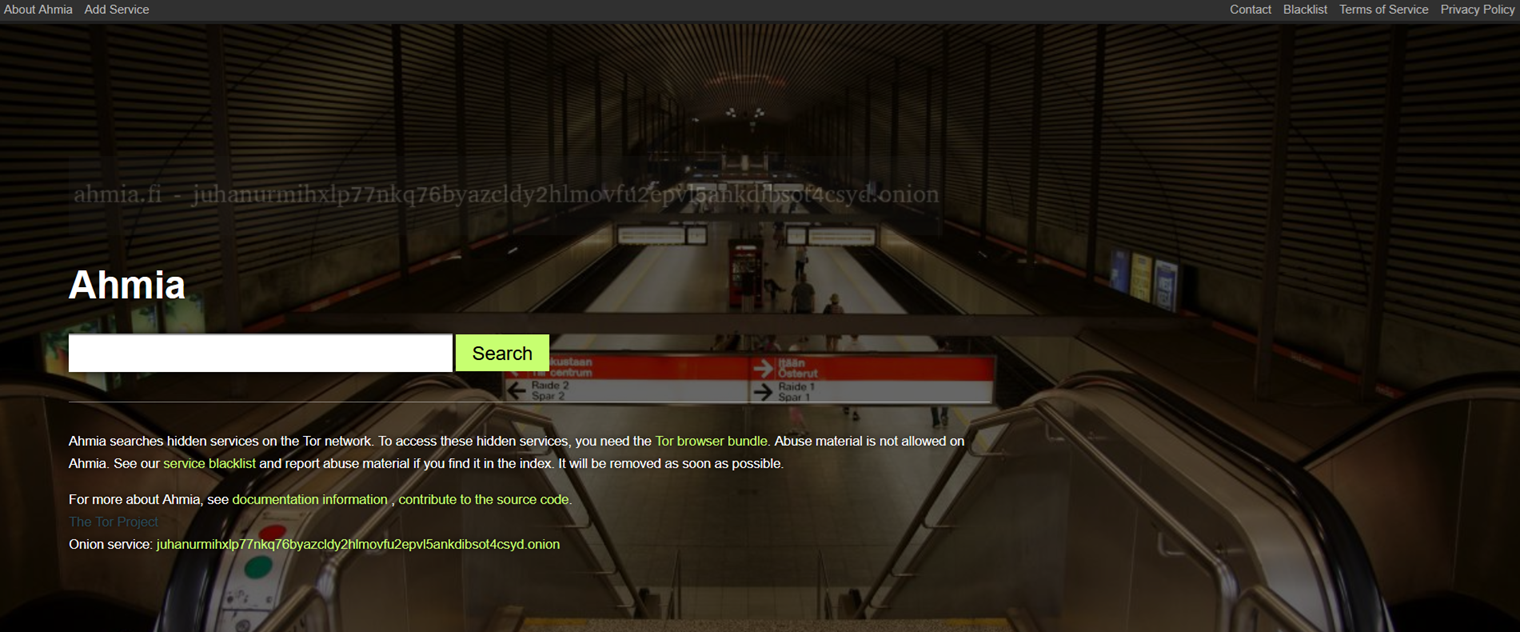
Ahmia is a Tor-compatible search engine that indexes public Tor hidden services while actively filtering abusive and illegal content. Like other privacy-focused engines, it relies on automated discovery and a basic architecture made up of a crawler, index, and website. Created by Juha Nurmi during Google Summer of Code, Ahmia was designed to improve the usability and safety of Tor search.
Unlike many darknet search engines, Ahmia uses blocklists, user reporting, and ongoing moderation to remove content related to exploitation, fraud-heavy traps, and other high-risk categories. Its filtering policy excludes child sexual abuse material, and Ahmia filters can also prevent related queries from appearing in results. That produces a smaller index, but it is a deliberate choice rather than a weakness. Ahmia is an open source project, which supports transparency around how it operates, though it does not make third-party listings trustworthy by default. Its codebase is open-source, reinforcing transparency and trust.
| Feature | Description | User Benefit |
|---|---|---|
| Active Filtering | Blocks abusive and illegal categories | Lower exposure risk |
| Tor-Endorsed | Officially supported by Tor Project | High credibility |
| Open Source | Public codebase | Transparency & trust |
| Dual Access | Clearnet preview + Tor network | Flexible research workflows |
Because the dark web changes constantly, onion links often go offline, and some pages may be missing because they are unreachable, not publicly crawlable, or excluded by policy. Ahmia also says it does not log IP addresses or identifiable search activity, which fits its privacy-focused design. Comparing similar engines can improve confidence in relevant results because each index has coverage gaps.
Why Ahmia Tops 2026 Rankings
In 2026 reviews by CloudSEK, Breachsense, Cyble, and DeXpose, Ahmia consistently ranks as the safest dark web search engine. Its emphasis on content filtering and legitimacy is a deliberate choice that produces a smaller index, and Ahmia filters out child sexual abuse material (CSAM) to support safer, more defensible research standards.
As AI-generated phishing sites and fake dark web forums increase, underground escrow abuse, Ahmia's curated approach can reduce exposure while still enabling meaningful discovery. This moderation also helps limit encounters with harmful content. Ahmia has also blocked all sexually related search terms since 2023 as part of its safety rules. This balance makes it ideal for beginners and professionals alike.
Ahmia is also a long-running open source project, and it does not store IP addresses or use cookies for search activity. Its architecture includes a crawler built with Scrapy and a search stack using Python 3, Django 5, and Elasticsearch 8, with Elasticsearch used to index search results.
Ahmia vs Other Dark Web Search Engines
Many search engines do not vet their results, which can expose users to scams and harmful content. Content filtering and curation reduce that risk by removing unverified links before they appear in results.
| Engine | Filtering | Index Depth | Best For | Risk Level |
|---|---|---|---|---|
| Ahmia | Strong | Moderate | Safe research & beginners | Low |
| Torch | None | Very Large; its claimed index size can still include inactive onion addresses | Broad OSINT scanning | High |
| Torzle App | None | Low | Safe research & beginners | Low |
| Haystack | Moderate | Large (paid tiers), like similar engines it offers only a point-in-time view | Advanced users | Medium |
| DuckDuckGo | High | Low; unlike hidden wiki directories, it is not a dark web index | Private, ordinary web searches | Low |
Risks and OpSec Best Practices
While Ahmia significantly reduces risk, no dark web search engine is completely safe. Malware, phishing, legal exposure, and browser fingerprinting remain possible if users go beyond ethical research boundaries. For security researchers, that means treating search results as untrusted leads rather than validated sources.
- Use only the official Tor Browser
- Enable the highest security settings
- Avoid sharing personal or identifying data
- Don’t download files or interact with pages that may contain illegal material
- If pages require JavaScript, remember the search can still work without it
- Cross-check findings with trusted directories
- Corroborate leaked credentials with internal evidence and fold dark-web findings into incident response through approved escalation paths
- Maintain a strict research-only mindset, since security professionals often pair Tor with privacy-focused surface web tools for related research
- Only visit verified vendors, markets and forum links
If you’re looking for more safety tips, check out our guide on How to Prevent Carding Fraud in 2026.
Conclusion: Why Ahmia Leads in 2026
Ahmia stands out as the top dark web search engine in 2026, thanks to its endorsement from the Tor Project, proactive filtering, and commitment to open-source transparency. While it may not have the extensive reach of some uncensored tools, its focus on safety perfectly aligns with the growing demands of users who prioritize privacy and security.
- Enable the highest security settings; some pages may require JavaScript, but keeping it disabled can reduce browser fingerprinting risk.
- Security researchers and security professionals should treat results as untrusted leads, avoid illegal material, and never download files from unknown onion pages.
- Any findings involving leaked credentials should be handled through incident response procedures and verified with internal evidence before action is taken.
As dark web threats become more sophisticated, filtered discovery tools like Ahmia are no longer optional—they are essential, and the short version is that its smaller, reviewed index is deliberate rather than incomplete.
To explore further with Torry.io lets you access the dark web conveniently from the Clearnet and Onionland a hybrid search engine.
Frequently Asked Questions
Is Ahmia safe to use in 2026?
Ahmia is considered the safest dark web search engine in 2026 due to active filtering and Tor Project endorsement, though all dark web use carries some risk.
What type of content does Ahmia filter?
Ahmia removes abusive and illegal categories, including exploitation material, through a filtering policy that uses blocklists and community reports; it also filters sites related to illegal content, blocks abusive material, and has shared banned domains with other services. That makes it safer than most tools and more transparent about moderation, but its public claims should not be treated as independently audited guarantees of total safety.
How is Ahmia different from Torch?
Ahmia focuses on safety and legitimacy, using a filtering policy that removes abusive material and sites tied to illegal content, including many illegal marketplaces, and it maintains a blocklist of roughly 60,000 banned onion domains. Torch prioritizes maximum coverage with no filtering, so Ahmia ends up with a smaller index but lower risk.
Who should use Ahmia?
Ahmia is ideal for journalists, researchers, OSINT analysts, students, beginners, and tor users seeking safer onion discovery. It uses a smaller index as a trade-off for filtering out illegal marketplaces and other higher-risk results, while Torch prioritizes breadth over screening.
Is accessing Ahmia legal?
Accessing Ahmia is legal in many jurisdictions, but interacting with illegal content is not. Ethical and lawful use is essential.