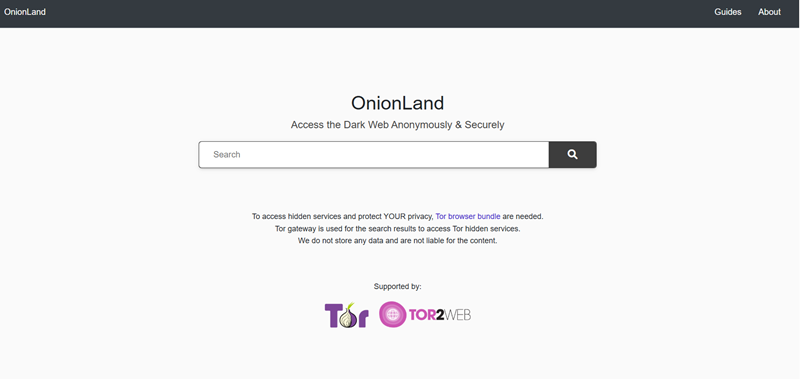
If you’ve ever felt overwhelmed trying to find useful .onion sites, you’re not alone. Most dark web search engines are either too basic, too risky, or limited to just Tor. That’s where OnionLand.io stands out in 2026.
OnionLand is a hybrid search engine that lets you search the dark web (Tor), I2P network, and even parts of the clearnet — all from one clean, Google-like interface. No more switching tabs or tools.
What Is OnionLand.io and How Does It Work?
OnionLand.io acts as both a search engine and a directory. It crawls and indexes .onion sites, I2P addresses, and selected surface-web results. You can filter by network or view blended results. It features autocomplete suggestions, a modern UI, and works through the Tor Browser (or their clearnet proxy for quick access).
It’s especially popular with researchers and curious users who want to explore without the chaos of purely uncensored engines.
Features and Functions
- Multi-Network Indexing: This tool lets you search through content on .onion (Tor) sites, I2P addresses, and select clearweb pages all in one go.
- Familiar Interface: It boasts a sleek, modern design with handy search suggestions and autocomplete features that feel just like the popular search engines you’re used to on the surface web.
- Filter Options: You can easily mix and match your search results or narrow them down to a specific hidden network, giving you more control over what you find.
- JavaScript Dependency: Keep in mind that many of the advanced features rely on JavaScript, which can potentially expose your identity or track you if it’s enabled in privacy-sensitive settings.
- Unfiltered Content: As with many dark web indexes, the results might lead you to links that are malicious, scams, or illegal content, so it’s crucial to tread carefully and stay vigilant.
Privacy and Security Risks
Visit Torlinks for curated .onion (tor) sites.
OnionLand.io vs Tordex vs Tor66 vs DuckDuckGo – 2026 Comparison
| Search Engine | Networks Indexed | Interface & Ease of Use | Filtering / Safety | Index Size | Best For |
|---|---|---|---|---|---|
| OnionLand.io | Tor + I2P + Clearnet (hybrid) | Excellent – modern, autocomplete | Medium (user must be careful) | Large (multi-network) | Exploratory research, beginners wanting variety |
| Tordex | Tor only | Basic but functional | Low – fully uncensored | Very Large (user-submitted) | Raw discovery, experienced users |
| Tor66 | Tor only | Good – categorized directory + search | Medium (some verification) | Medium–Large | Categorized browsing, backup index |
| DuckDuckGo (Onion) | Clearnet / Surface web only | Excellent – familiar & private | High (no tracking) | Huge (surface web) | Anonymous everyday searches on Tor |
How Onion Addresses Work
Onion addresses power the hidden services that make up most of the Tor network. Instead of using the public DNS system, each .onion site is identified by a long cryptographic string generated from a public key. When you enter one of these addresses into the Tor Browser (often called the tor onion browser), your connection is wrapped in multiple layers of encryption and routed through volunteer relays. Neither the site’s real server location nor your IP address is revealed. Regular browsers cannot open these onion websites; only Tor-compatible software can resolve them. OnionLand.io indexes these addresses so users can discover them and then visit safely inside Tor.
Legitimate Uses
Far from being only a haven for illicit activity, onion websites support many lawful purposes. Journalists and whistleblowers use them to exchange information without exposing sources. Human-rights groups and activists in censored countries rely on Tor for uncensored news and secure communication. Researchers studying network security or online privacy examine how information moves when conventional channels are blocked. Everyday users simply seeking stronger anonymous browsing also turn to the network to reduce tracking by advertisers and data brokers. Torch Dark Web Search Engine 2026 helps surface these legitimate destinations by offering a clean, multi-network search experience.
Benefits and Limitations
The main benefit is enhanced online privacy. Properly used, Tor makes it difficult for ISPs, websites, or third parties to link activity back to an individual. End-to-end encryption between the client and the hidden service adds another layer of protection. The trade-offs are speed and reliability: traffic travels through several relays, so pages load more slowly, and some onion websites go offline without warning. Users must still practice caution, avoid downloading unknown files, and keep personal accounts separate from Tor sessions.
Dark Web Guide
Start by downloading the official Tor Browser and verifying the file. Keep the security slider at “Safer” or higher for most browsing. Prefer searching from OnionLand.io’s own .onion address when available so the entire session stays inside the network. Cross-check results with established indexes and treat every new link with skepticism until its reputation is confirmed. Never mix clearnet logins with Tor activity, and disable unnecessary scripts on sensitive sites. OnionLand.io’s hybrid design—covering Tor, I2P, and selected clearnet pages—makes discovery more practical for people focused on anonymous browsing and online privacy. Used responsibly, it supports legitimate research and privacy needs without requiring users to navigate the dark web blindly. Tordex vs OnionLand Comparison is another option for a better result on your dark web search journey.
What Are Onion Services?
Onion services are private websites and applications accessible solely through the Tor Network via the Tor Browser. They conceal the user and server's location and IP address, ensuring complete end-to-end encryption, and utilize .onion addresses instead of standard domains.
Key Features
- Anonymity: Both the user and server remain hidden.
- Strong Encryption: Traffic is fully encrypted within the Tor network, reducing reliance on external security tools like HTTPS.
- No Traditional Domain Needed: Addresses are generated cryptographically from public keys, ending in .onion.
Common Uses
Quick Pros & Cons
- OnionLand.io Pros: Hybrid multi-network search, clean modern UI, great for cross-referencing.
- OnionLand.io Cons: Requires JavaScript (slightly reduces privacy), no heavy content filtering.
- Tordex Pros: Massive uncensored index.
- Tordex Cons: High risk of bad links.
- Tor66 Pros: Organized categories.
- DuckDuckGo Pros: Best privacy for normal web searches.
- DuckDuckGo Cons: Does not index dark web .onion sites.
VPN + OnionLand.io in 2026: Best Balance of Privacy & Convenience
| Setup | Privacy Level | Convenience | Speed | Best For | Main Drawback |
|---|---|---|---|---|---|
| VPN + OnionLand.io | High | ★★★★★ | Fast | Daily hybrid dark web browsing | Minor speed trade-off |
| OnionLand.io Alone | Medium | ★★★★★ | Very Fast | Quick multi-network searches | JavaScript reduces anonymity |
| VPN + Tor Browser + Tor66/Tordex | Excellent | ★★★☆☆ | Medium | Maximum anonymity | Slower, more complex |
| DuckDuckGo Onion + VPN | Very High | ★★★★★ | Fast | Private surface-web searches | No dark web indexing |
If you're interested in diving into our detailed reviews of privacy-centric browsers and search tools, be sure to check out Ahmia, Torry onion browser, and Excavator tor browser.
2026 Recommendation: For most people, VPN + OnionLand.io gives the perfect mix of privacy and ease. It protects your real IP while letting you explore Tor, I2P, and clearnet seamlessly. See our latest 2026 VPN guide for dark web safety.
Is OnionLand.io Safe to Use in 2026?
Yes — when used responsibly. It’s more user-friendly than fully uncensored engines like Tordex, but you should always verify links and never click blindly. Pairing it with a no-logs VPN adds strong protection against your ISP or network monitoring.
Final Verdict
In 2026, **OnionLand.io** is one of the most practical hybrid dark web search engines available. It’s ideal if you want one tool that covers Tor, I2P, and clearnet without switching engines. For pure .onion discovery, combine it with Tor66 or Tordex. For everyday private searching, DuckDuckGo’s onion service still wins.
FAQ: OnionLand.io & Dark Web Search in 2026
1. Does OnionLand.io require the Tor Browser?
Yes for full .onion and I2P access. It also has a clearnet version for quick testing.
2. Is OnionLand.io better than Tordex or Tor66?
It depends. OnionLand wins on modern interface and multi-network support. Tordex is better for raw volume; Tor66 for organized categories.
3. Can I use OnionLand.io on mobile?
Yes, but only through Orbot + Tor Browser on Android. The clearnet version works in any mobile browser.
4. How does OnionLand compare to DuckDuckGo for dark web use?
DuckDuckGo is excellent for private surface-web searches on Tor, but it does not index .onion sites. OnionLand is built specifically for hidden services.
5. Should I use a VPN with OnionLand.io?
Absolutely recommended in 2026. It hides your traffic from your ISP and adds protection even when using Tor.
References & Further Reading
- Torry.io Review 2026 – Another Easy Dark Web Search Option
- Official OnionLand.io documentation and Tor Project resources
- Independent 2026 dark web search engine comparisons (CloudSek, Cyble, BreachSense)
Disclaimer
This article is for educational and cybersecurity awareness purposes only. Always practice good OPSEC. Never use dark web tools for illegal activity. Verify every link before clicking.